Train around your task
Your products, containers, and movements become the starting point for teaching the robot.
A new hand in food production
We’re building robot workstations that learn your packing and placement tasks. Made for growing food manufacturers, with one team behind the training, setup, and ongoing support.
Built around your floor.
01 / The work
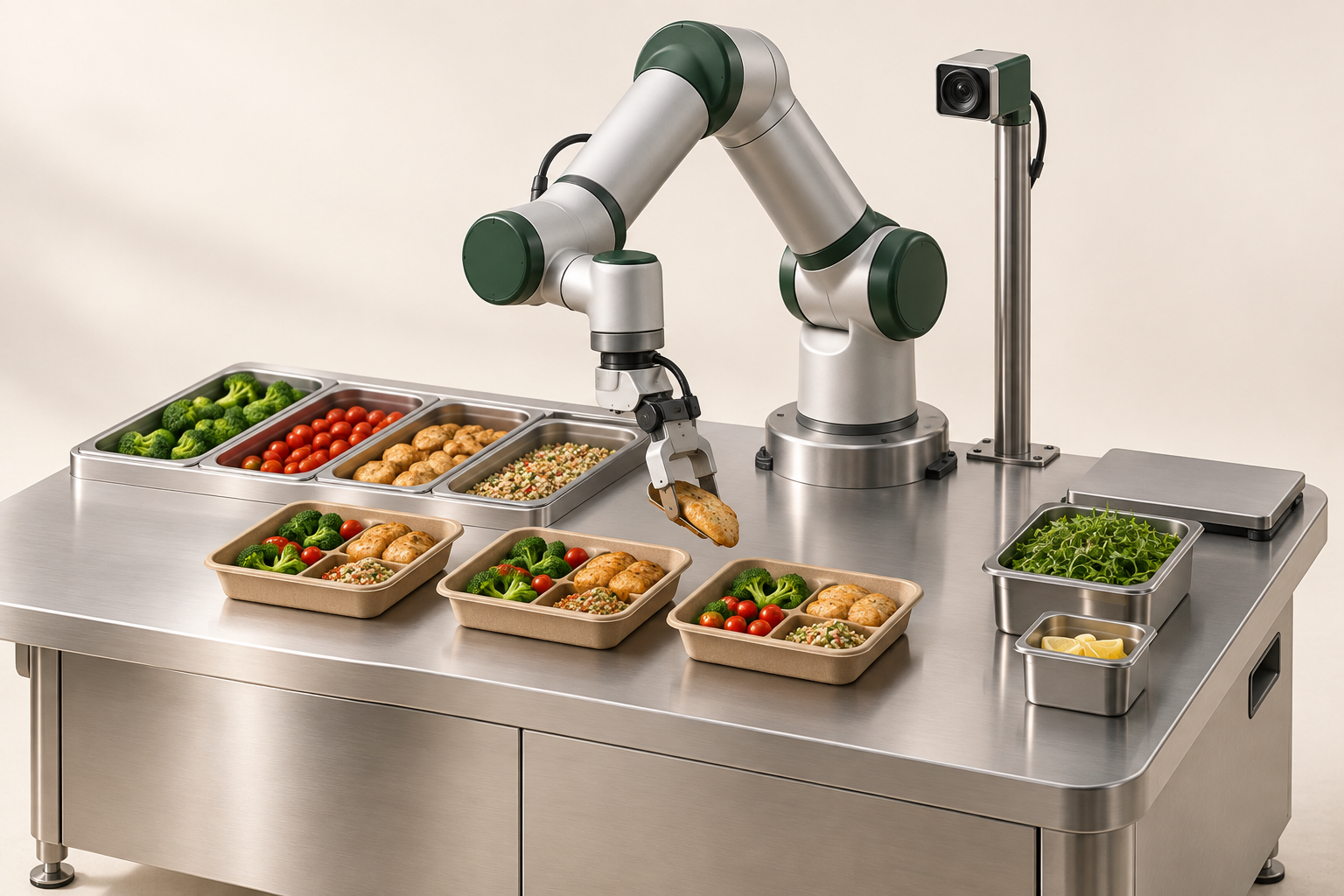
The repeated movements behind a finished meal are our starting point. We focus on useful, well-defined tasks that fit into the way you already produce.
Prepared meals, produce trays, and repeatable placement tasks.
Meal assembly, sauce inserts, and final packing steps.
Product-specific filling, with weight or count checks suited to the task.
Our development focus. Each task is assessed and tested with the actual product, packaging, and production conditions.
02 / More than a machine
Automation should come with the people who make it useful. Our approach brings the workstation, task training, and ongoing technical support together.
From first conversation to your floorYour products, containers, and movements become the starting point for teaching the robot.
The arm, tooling, cameras, and layout are considered together, around the space and flow you have.
Setup, operator guidance, and technical support are part of the plan from the first conversation.
Use what each task teaches us to refine the workstation and prepare for the next product or process.
03 / From your process to our practice
A practical path to automation starts with a specific job. We shape the workstation around that job, then earn the next step through testing.
Look at your products, pace, layout, and handling requirements. Choose a task with a clear outcome.
Demonstrate the task on a robot workstation. Train around the variations that show up in your process.
Check handling, consistency, cycle time, and where people need to step in, using representative products.
Plan a supported introduction at your station, with operator guidance and a clear path for improvements.
04 / Close to the work
We bring software and machine learning expertise to the everyday work of food production.
Based between Palo Alto and Almaty, we’re building for medium-sized food manufacturers. Our ambition is practical: make useful robotics easier to bring into an existing workstation, one well-learned task at a time.
A few things to know
Prepared meals, produce packing, and similar food assembly workflows. We’re interested in repeated picking, placement, and packing tasks at a defined workstation, especially for medium-sized manufacturers.
Our starting point is a single workstation within your existing process. We assess the space, product presentation, cleaning needs, and handoffs with your team to understand what changes that task would require.
We’re developing and training our first food-handling workstations. Right now, we’re interested in conversations with manufacturers about specific tasks. Any introduction to a production floor follows task testing and a shared plan with your team.
Adaptation is part of the approach. We assess the new product or pack, update the tooling or training where needed, and test the changed task before it enters the workflow.
Let’s start with your workstation
What are you packing? How does the task work today? Tell us where an extra pair of hands could make a difference.
Discuss your workstation dana@ykenistik.com